Argentina faces potential FIFA action over Falklands banner display
Argentina faces potential FIFA disciplinary action after displaying a controversial Falkland Islands banner following their 2-1 World Cup semi-final win against
Messi is a sorcerer but he is surrounded by utter scoundrels
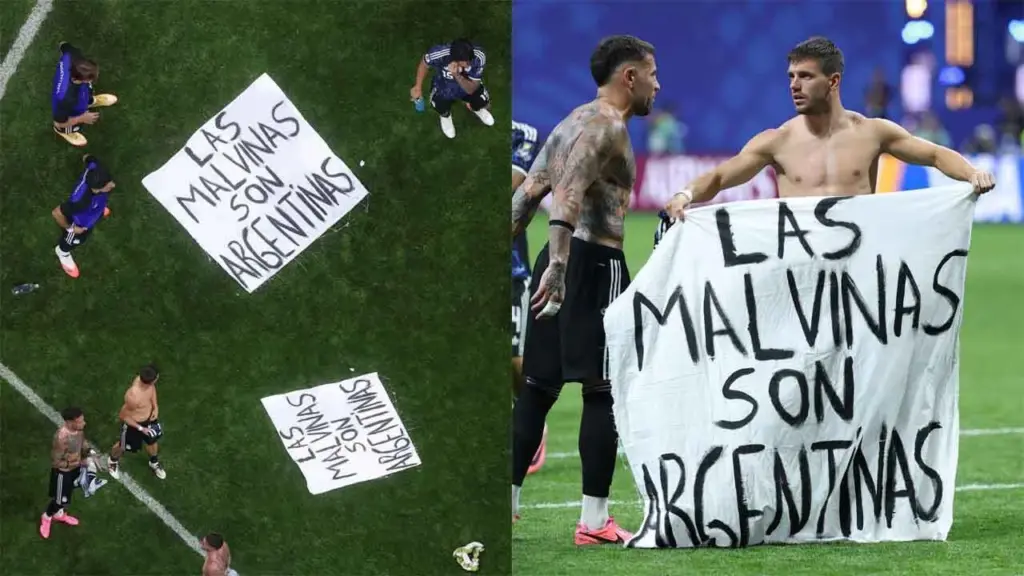
The Argentinian national football team could face disciplinary action from FIFA following the display of a controversial banner referencing the Falkland Islands. The incident occurred after Argentina secured a 2-1 victory over England in the semi-finals of the FIFA World Cup 2026.
During post-match celebrations at the Atlanta Stadium, several Argentinian players, including Giovani Lo Celso, Lisandro Martínez, and Nicolas Otamendi, were seen holding a banner that read “Las Malvinas son Argentinas.” This phrase translates to “Malvinas are Argentinian,” referring to the Spanish name for the Falkland Islands, a British overseas territory also claimed by Argentina.
Controversy surrounding the banner
The display of the banner may violate FIFA’s regulations concerning political messages. The organisation’s stadium code of conduct for the 2026 World Cup prohibits materials, including banners and flags, that are political, offensive, or discriminatory. The International Football Association Board (IFAB), football’s top lawmaking body, also has clear rules against political messaging on the field, stating that players’ equipment must not feature political, religious, or personal slogans, statements, or images.
For any violation of these rules, the player and/or the team may face sanctions from the competition organiser, national football association, or FIFA. It remains unclear whether the players brought the banner themselves or received it from supporters in the crowd.
This is not the first time Argentina has faced such a situation. In 2014, the Argentine Football Association was fined for a similar incident where players posed with a banner bearing the same text. FIFA had then cited a breach of its rules on “political action” and team misconduct.
Historical context of the dispute
The sovereignty of the Falkland Islands has been a long-standing point of contention between Argentina and the United Kingdom. The islands have been under de facto British control since 1883, with the exception of a two-month period in 1982 when Argentina’s military junta-led government briefly seized control, leading to the Falklands War.
The conflict concluded in June 1982 with an Argentinian surrender and the British regaining control. Despite the military defeat, Argentina continues to assert its claims over the islands, having amended its constitution in 1994 to reflect this stance. Residents of the islands have, however, voted overwhelmingly in referendums to remain a British overseas territory.
Days before the semi-final match, Argentina’s Ministry of Foreign Affairs issued an official communiqué reaffirming the country’s claim over the islands. The statement protested against unnotified movements of the HMS Medway towards the Argentinian continental coast, describing them as a violation of bilateral agreements and a British military incursion into areas under Argentinian jurisdiction.
FIFA has not yet commented on whether it intends to take action against the Argentinian team, and it is also uncertain if the English Football Association will file any complaints regarding the matter. Argentina’s vice-president, Victoria Villarruel, shared a clip on X appearing to show Argentinian soldiers landing on the islands in 1982, stating, “it wasn’t just another match,” and adding, “The Malvinas are Argentine! They banned us from bringing them to the stadium, but they forgot that we carry them in our blood and in our hearts.”
Read Also
- Argentina could face disciplinary action after displaying Falklands banner
- Gill's Edgbaston chase highlights his role as India's ODI batting standard-bearer
- Messi and Yamal to meet in World Cup final after nearly two decades since first encounter
- Atlanta: Heated exchange between Jude Bellingham and Lionel Messi during World Cup semifinal
Source: forbes.com

Rohan Gupta
Sports Reporter