Indian students achieve five gold medals at International Physics Olympiad
Indian students made history at the 56th International Physics Olympiad 2026, securing five gold medals and ranking joint World No. 1. Read more about this incr
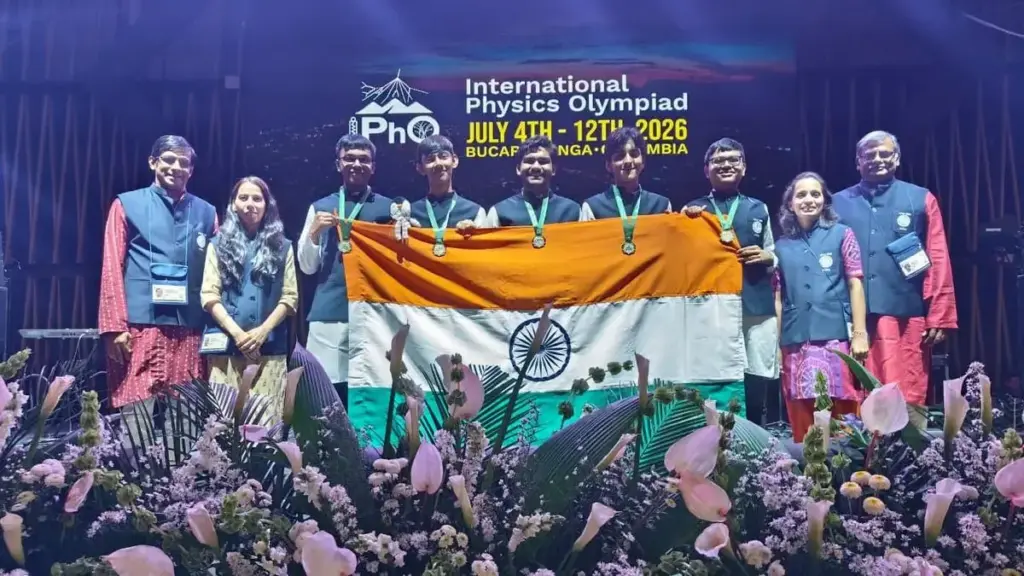
We know our cricket stars by heart. But do you know the five Indian students who just made the country world No. 1 in Physics?
India has achieved a significant milestone at the 56th International Physics Olympiad (IPhO) 2026, with all five participating students securing gold medals. This performance, which took place in Bucaramanga, Colombia, from July 5 to July 12, positioned India as joint World No. 1 alongside nations such as China, Russia, Kazakhstan, South Korea, and Taiwan.
This marks only the second time that India has achieved a clean sweep of five gold medals at this prestigious competition, the other instance being in 2018. The Indian team comprised Kanishk Jain from Pune, Riddhesh Anant Bendale from Indore, Rishit Garg from Dwarka, Delhi, Shresth Suraiya from Mumbai, and Svarit Joshi from Ahmedabad. Each student competed against 381 students from over 85 countries and successfully earned a gold medal.
India’s Olympiad Programme Strength
The Department of Atomic Energy (DAE) highlights this achievement as a reflection of the strength of India’s Olympiad programme. This programme is coordinated by the Homi Bhabha Centre for Science Education (HBCSE), which is a National Centre of the Tata Institute of Fundamental Research (TIFR). The HBCSE is the anchor institution for the Indian team, providing crucial support and training.
The selection process for the International Physics Olympiad involves multiple stages of national-level examinations to identify talented students. Following selection, these students undergo rigorous training camps. These camps are designed to prepare the final five-member team to compete at the highest international level, equipping them with advanced theoretical and experimental skills.
Prof. Anwesh Mazumdar of HBCSE – TIFR, who accompanied the team to the event, noted the team’s exceptional diligence in both the theory and experiment rounds, leaving little room for mark deductions. The Indian contingent was also accompanied by Dr Leena Joshi of St Xavier’s College, Mumbai, and two Scientific Observers, Prof. Ananda Dasgupta of the Indian Institute of Science Education and Research Kolkata, and Nisha Kelkar of Gogate-Joglekar College, Ratnagiri.
The Rigour of the Competition
The International Physics Olympiad is recognised as one of the most challenging academic competitions globally. Unlike typical entrance examinations that often test speed and familiarity with question patterns, the IPhO demands original thinking and a deep understanding of physics principles. The competition includes a five-hour theoretical examination and another five-hour experimental examination.
The theoretical component featured three problems covering diverse topics, including the thermodynamics of paramagnetic cooling, photoionisation of ozone, and the dynamics of electron-positron pairs. Indian students performed exceptionally well in this section, with some achieving scores close to perfect. The experimental component challenged students to explore phenomena related to thermodynamic processes in fluids and heat transfer, where the Indian team also demonstrated remarkable performance.
Malay Krishna, a product leader and former JEE Physics teacher, commented on the distinct nature of this achievement. He explained that the Olympiad requires students to think through problems they have never encountered before, a skill that differs significantly from preparing for known question patterns in competitive exams. He highlighted that there is no shortcut or formula sheet that can guarantee success; instead, it demands a genuine understanding of physics.
India’s consistent performance at the IPhO supports the effectiveness of its publicly funded Olympiad ecosystem. This was India’s 27th appearance at the competition. Over the past decade, every Indian participant has returned with a medal, with a majority earning gold medals. Historically, approximately 44 per cent of Indian students have won gold medals, 41 per cent silver, and 10 per cent bronze, with 5 per cent receiving honourable mentions.
The success of these students, however, also brings attention to the broader issue of nurturing scientific talent within the country. While a significant proportion of India’s Olympiad medallists pursue doctoral research, many eventually build their careers abroad. According to data, 64 per cent of Olympiad medallists have chosen an academic career, defined by pursuing a PhD in any subject, while 32 per cent of medallists, whether academic or not, have settled in India.
The achievement of these five young physicists has placed India among the world’s best in a demanding science competition. The 56th International Physics Olympiad concluded on July 12, 2026.
Read Also
- Indian cricketer Vaibhav Sooryavanshi attends Wimbledon men's singles final
- Argentina advance to World Cup semifinal after defeating Switzerland
- Airline wager sees Norwegian Air adopt British Airways' colours after World Cup quarter-final
- Las Vegas: Conor McGregor's UFC return ends after 69 seconds due to knee injury
Source: timesofindia.indiatimes.com

Rohan Gupta
Sports Reporter