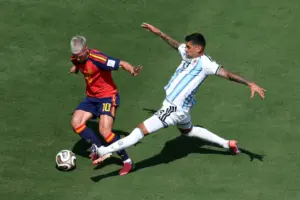
Spain secures World Cup title with extra-time winner against Argentina
Spain defeats Argentina 1-0 in extra time to win their second World Cup title, with Ferran Torres scoring the decisive goal. Messi’s hopes of retaining the trop
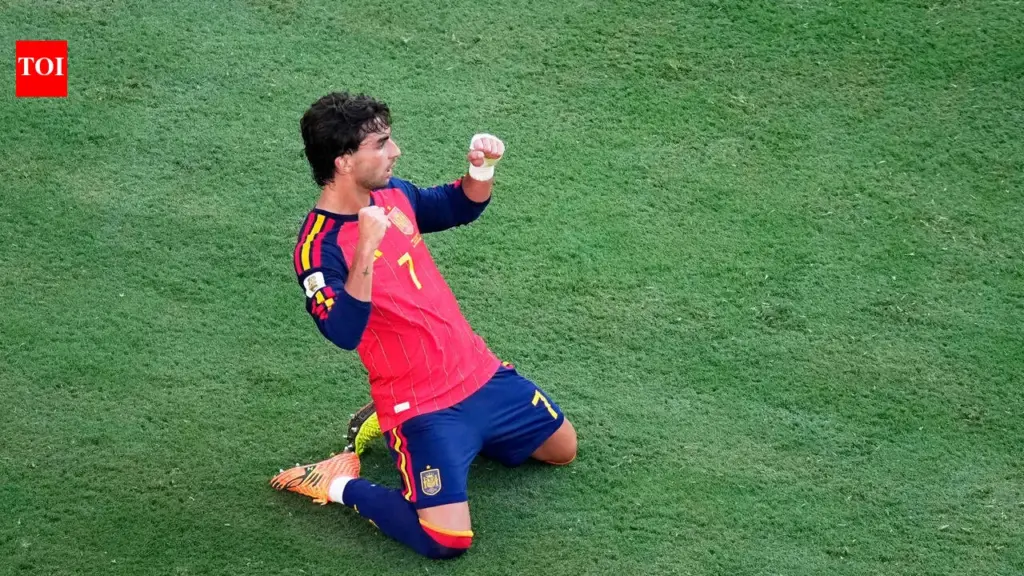
Spain 1-0 Argentina (aet): 2026 World Cup final player ratings
Spain clinched the World Cup title following a 1-0 victory over Argentina, with Ferran Torres scoring the decisive goal in extra time. The win marked Spain’s second World Cup triumph and ended Lionel Messi‘s aspirations of retaining the trophy.
The match saw Spain dominate possession and create numerous opportunities, though the score remained goalless through 90 minutes. Argentina’s resistance was eventually broken in the 106th minute, just 37 seconds into the second period of extra time, when Torres found the back of the net.
Torres’ Decisive Strike
The winning goal originated from a well-executed Spanish play. Pedro Porro delivered a deep cross into the penalty area, which Nico Williams intelligently headed back across goal. Torres then timed his run perfectly, unleashing a left-footed finish that nestled into the roof of the net.
This breakthrough came after Emiliano Martínez, Argentina’s goalkeeper, had made several outstanding saves to keep his team in contention. Spain’s relentless pressure was evident throughout the game, with the team registering 15 shots in regulation time compared to Argentina’s none, and earning nine corners to Argentina’s one.
Argentina’s challenge was compounded when Enzo Fernández received a second yellow card for a reckless tackle on Pau Cubarsí in second-half stoppage time, leading to his dismissal. Playing with 10 men, the defending champions were unable to recover after Torres’ goal.
Player Performances and Key Moments
For Spain, several players delivered strong performances. Rodri, the 2024 Ballon d’Or winner, was particularly influential in midfield, demonstrating his commanding style. Dani Olmo was central to many of Spain’s attacking moves, while Lamine Yamal showed determination, with the young player now a world champion.
Substitutes also played a crucial role. Ferran Torres, who replaced Mikel Oyarzabal in the 62nd minute, not only scored the winner but also had an earlier chance shortly after coming on. Pedri, introduced for Fabián Ruiz at the same time, seamlessly took over in midfield. Nico Williams, who came on for Álex Baena, injected urgency and provided the assist for Torres’ goal, despite having an earlier goal disallowed.
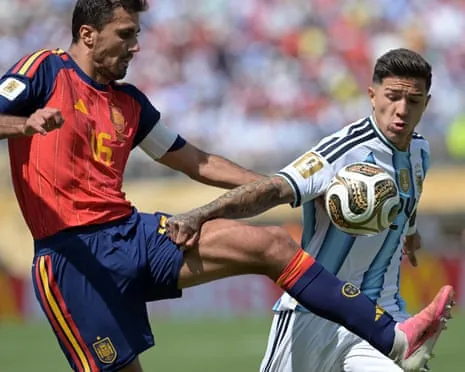
Argentina’s efforts were hampered by injuries and dismissals. Cristian Romero was forced off with an injury after a battling display, and Lisandro Martínez also picked up an injury that ended his afternoon prematurely. Enzo Fernández’s red card further complicated matters for Argentina.
Lionel Messi, despite his best efforts, could not inspire his team to a second consecutive World Cup title. His performance was not the swansong he might have envisioned.
Ferran Torres’ Career Highlights
Ferran Torres García is a Spanish international forward who plays for Barcelona and the Spain national team. Known for his intelligent movement and clinical finishing, Torres can operate as both a winger and a central striker.
His professional career began with Valencia in 2017 before a move to Manchester City in 2020, where he won the Premier League and the EFL Cup. He joined Barcelona in January 2022. After an initial period of inconsistency, Torres became a vital player for Barcelona, contributing to their domestic treble-winning campaign in 2024-25 and scoring 21 goals in the season that followed, helping the Catalan giants reclaim the La Liga title.
On the international stage, Torres has represented Spain at UEFA Euro 2020, the 2022 FIFA World Cup, and UEFA Euro 2024, where Spain lifted the European Championship. His extra-time winner against Argentina has now cemented his place in Spanish football history.
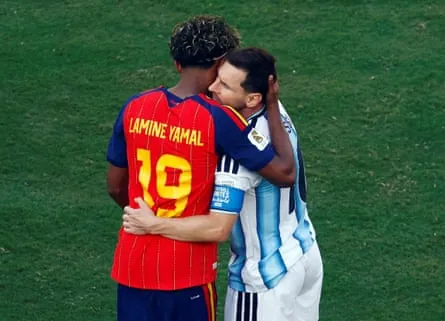
The victory also marked a historic achievement for Spain, as they became the first nation to simultaneously hold both the men’s and women’s FIFA World Cup titles.
Read Also
Source: theguardian.com

Rohan Gupta
Sports Reporter