Dutch defeat ends economist’s World Cup prediction streak
Economist Joachim Klement’s World Cup prediction streak ends as his model, which tipped the Netherlands to win, fails for the first time in four tournaments.

‘I ran out of luck’: Dutch defeat ends economist’s run of World Cup winning predictions
Economist and football forecaster Joachim Klement has seen his streak of correctly predicting World Cup winners come to an end. For the first time in four men’s tournaments, Klement’s model failed to identify the eventual champion, after his economic models pointed towards the Netherlands winning this year’s competition. Klement had previously accurately predicted the winners of the 2014, 2018, and 2022 tournaments.
The Netherlands exited the tournament in the last 32, which Klement attributed to the unpredictable nature of penalty shootouts and some missed opportunities from the spot. This outcome marks the end of a 12-year run of successful predictions for Klement.
Writing on his investment blog, Klement reflected on the result, stating, “Eventually, after 12 years and being lucky in three World Cups, I ran out of luck.” He added that his initial goal in creating the model was to demonstrate that economic models are not as precise as many believe, and in this instance, he felt proven right.
Unforeseen Outcomes and Reactions
The Dutch team had a strong performance in the group stage, including a 5-1 victory over Sweden, which saw them top Group F. However, their journey concluded earlier than Klement’s model had anticipated. Klement acknowledged the unpredictable nature of knockout matches, noting that many could have gone differently, especially those decided by penalty shootouts.
Klement’s model also made another prediction that did not materialise. It suggested that Japan would eliminate Brazil early in the tournament. However, Gabriel Martinelli‘s stoppage-time goal for Brazil prevented this upset. Following this, Neymar of Brazil posted a message on X, encouraging Klement to “Please try again in the next World Cup.”
In response to Neymar‘s comment, Klement expressed his support for Brazil, stating, “after last night I dare to believe as well.” Klement’s model had also predicted Germany would advance to the last 16, which did not occur. Klement mentioned that he had previously stated he could face significant embarrassment if Japan, Germany, and the Netherlands all lost within a 12-hour period.
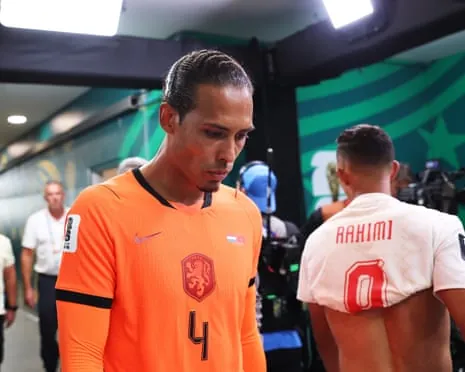
Despite the recent setbacks, Klement congratulated Brazil and its fans, as well as Paraguay and Morocco for their upsets. He also offered an apology to the Japanese national football team and their fans for their loss, commending them for showing the world their strength as a team. Similarly, he apologised to the Dutch national team and the Dutch people if he had given them false hope, acknowledging their misfortune in the tournament.
The Future of Forecasting
Klement, who holds master’s degrees in mathematics and economics & finance, initially developed his model in 2014 to illustrate the role of luck in predictions, particularly in economics. He had been surprised by his initial success, which led him to continue the forecasting exercise. He explained that he continued because he kept getting lucky, and he wanted to demonstrate that luck is a significant factor.
He noted that his model, which considers factors such as FIFA World Ranking, GDP per capita, population, and climate, is specifically designed for World Cups and does not apply to continental or club competitions. Klement highlighted that while systemic factors account for approximately 55% of prediction power, luck contributes around 45%. He reiterated that football matches are inherently unpredictable, which is part of their appeal.
Despite the recent outcome, Klement confirmed that he plans to return with new forecasts for the next World Cup in four years. He hopes that by then, people will have a better understanding of his central message: that luck is the most crucial factor, and no model can achieve perfect predictions. He aims to continue making World Cup forecasts as long as it remains a source of enjoyment and entertainment.
Read Also
Source: theguardian.com

Rohan Gupta
Sports Reporter