FIFA Power Rankings update for World Cup 2026 sees new leaders emerge
Discover the new leaders in FIFA Power Rankings for World Cup 2026 after the group stage! See who’s topping offensive, creative, and defensive charts. Get the l
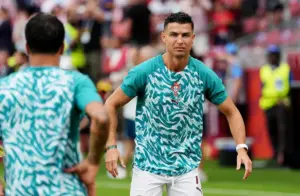
Messi Is Not The No. 1 World Cup 2026 Performer In FIFA Rankings, Not Even Mbappe Or Haaland. Ronaldo Is 79th
The latest update to the FIFA Power Rankings for the World Cup 2026, following the second day of the group stage, has introduced new leaders across various performance categories. This ranking system, based on statistical data, evaluates players’ offensive, creative, and defensive contributions during the international tournament. Players must have played at least 20 minutes to be included in the evaluation.
Previously, Lionel Messi held the top spot overall. However, despite scoring twice against Austria in a 2-0 victory, the Argentine player has been surpassed. The new overall leader is Germany’s Deniz Undav, whose two goals against Ivory Coast earned him the highest offensive rating of 8.94. Undav now leads Messi, who has an overall rating of 8.36, and Kylian Mbappé, who scored two goals against Iraq and holds a rating of 8.08.
Key Performers in Attacking and Creativity
In the attacking category, several players have demonstrated strong performances. Leroy Sané achieved an attacking score of 8.2 after scoring in the first half of a match. Nicolas Pépé also recorded an attacking score of 8.5 with two strikes. Hazem Mastouri was recognised as the best-rated attacking player in his game, with two attempts at goal and one scored. Anthony Elanga, from Newcastle, earned an attacking score of 9.1 after scoring Sweden’s equaliser and completing five take-ons and six ball progressions.
Cristian Volpato consistently advanced Australia into attacking areas, completing eight take-ons and securing an attacking score of 5.90. Sebastian Berhalter was identified as the most potent attacking threat in his game, scoring for Mauricio Pochettino’s side and earning an attacking score of 9.01.
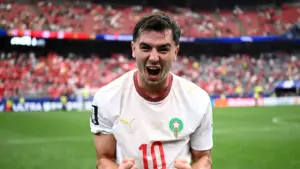
For creativity, France’s Michael Olise currently leads the tournament, with a score of 8.14, attributed to his two assists against Iraq. He is followed by Paraguay’s Julio Enciso, with a score of 7.87, and Morocco’s Brahim Diaz, who has a score of 7.53. Enciso also recorded 12 ball progressions and seven take-ons in a match, earning a creativity score of 5.74.
Other notable creative performances include John Yeboah, who had four progressive passes and two midfield unit line breaks, resulting in a creativity score of 7.7. Tahith Chong completed eight ball progressions and four progressive passes for a creativity score of 8.0. Hannibal Mejbri earned a creativity score of 8.9 for his assist for Tunisia’s only goal and eight ball progressions. Ritsu Dōan was the best creative outlet in his game with one assist, earning a creativity score of 8.0. Arda Güler completed 10 progressive passes and four ball progressions, achieving a creativity score of 8.33.
Defensive Strengths and System Details
On the defensive front, Canada’s Derek Cornelius maintains his leading position with a score of 7.48. He is ahead of Belgium’s Brandon Mechele, with a score of 7.33, and Cape Verde’s Pico Lopes, who has a score of 7.16.
Individual defensive highlights include Pedro Vite of Ecuador, who completed three interceptions and won three duels, earning a defending score of 7.2. Guéla Doué recorded the highest defending score in his match, 8.2, through eight possession regains and two duels won. Virgil van Dijk was recognised as the best defensive player in his game, with a defending score of 6.8, due to nine possession regains, six interceptions, and six possession contests won.
Ao Tanaka of Japan impressed with five blocks, involvement in 11 forced turnover involvements, and ranking second in clearances in the defensive third, earning a defending score of 7.1. Lucas Herrington of Australia achieved a defending score of 7.97, winning five clearances and completing 15 possession regains. Joe Scally of the USA made one clearance, four interceptions, and six possession regains, resulting in a defending score of 6.58.
The FIFA Power Ranking system was introduced for the World Cup 2026 to provide objective, data-driven insights into player performance. All outfield players receive scores between 0-10 in three categories: attacking, creativity, and defending. Goalkeepers are scored in two categories: in possession and defending the goal. A ‘Power Ranking Classification’ is released after each match round, detailing the top 100 players in each category. This evaluation system was established by Arsène Wenger.
Read Also
Source: onefootball.com

Rohan Gupta
Sports Reporter